Senior product designer bridging human impact and technical complexity. Builds enterprise platforms, consumer products, and campaigns at companies like Etsy and Uber.
Some recent work: Enterprise Logistics / Redesigned Payments / Ad Platform / AI-Powered Validation
Ghost
Zero-to-one logistics platform at enterprise scale
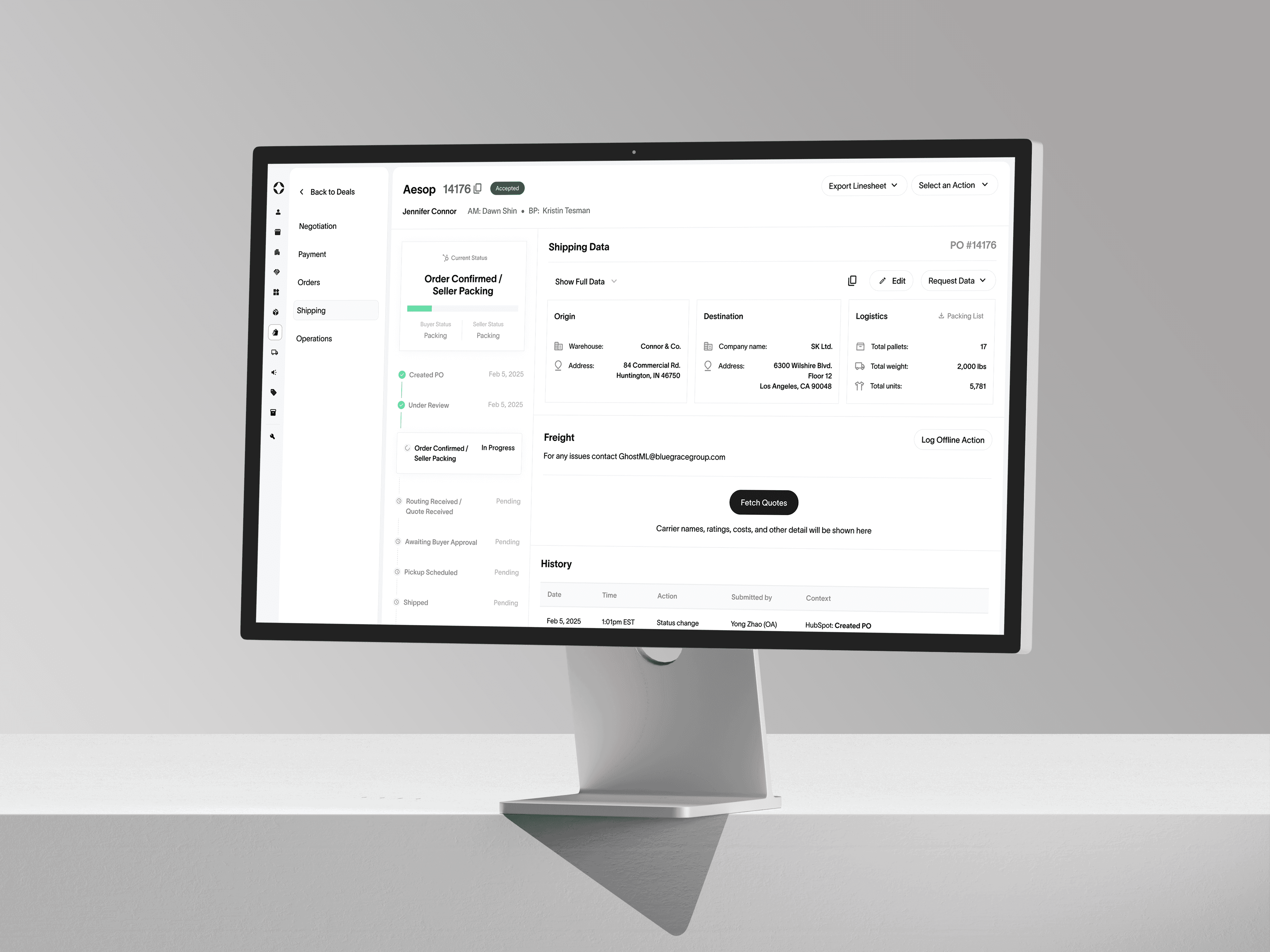
Ghost is a private distribution platform for the world’s best brands. Operations teams support millions in monthly volume but spent 4-6 hours daily managing freight across 5+ disconnected tools.
^ New comprehensive, consolidated tooling
My Role
End-to-end strategy and design
Alignment across 8 roles
Balance of competing constraints
Impact
Unified freight platform (nine-figure AOV)
75% reduction in manual work
Replacement of third party tools
Business Challenge
Operations relied on disconnected tools, a strategic gap impacting audit trails and ship times. Leadership tasked me with designing a zero-to-one freight product, consolidating workflows.
^ Workflow chaos (from quotes to buyer/seller communications to booking)
Breaking Down the Problem
The ultimate challenge wasn't building a freight tool but navigating technical and organizational constraints. I needed to integrate with existing systems, our shipping providers API requirements didn't map to our data models, and our 8 user roles had opposing needs.
^ Early explorations
Architecturally, I was designing for two distinct experiences: feature-rich admin dashboard and a simplified buyer flow.
Impact
My unified platform yielded:
75% reduction in manual work
Support for multi-millions of monthly order value
Built-in document compliance for each order’s significant paper trail
Automated financial reporting and reconciliation
^ Internal and externai touchpoints
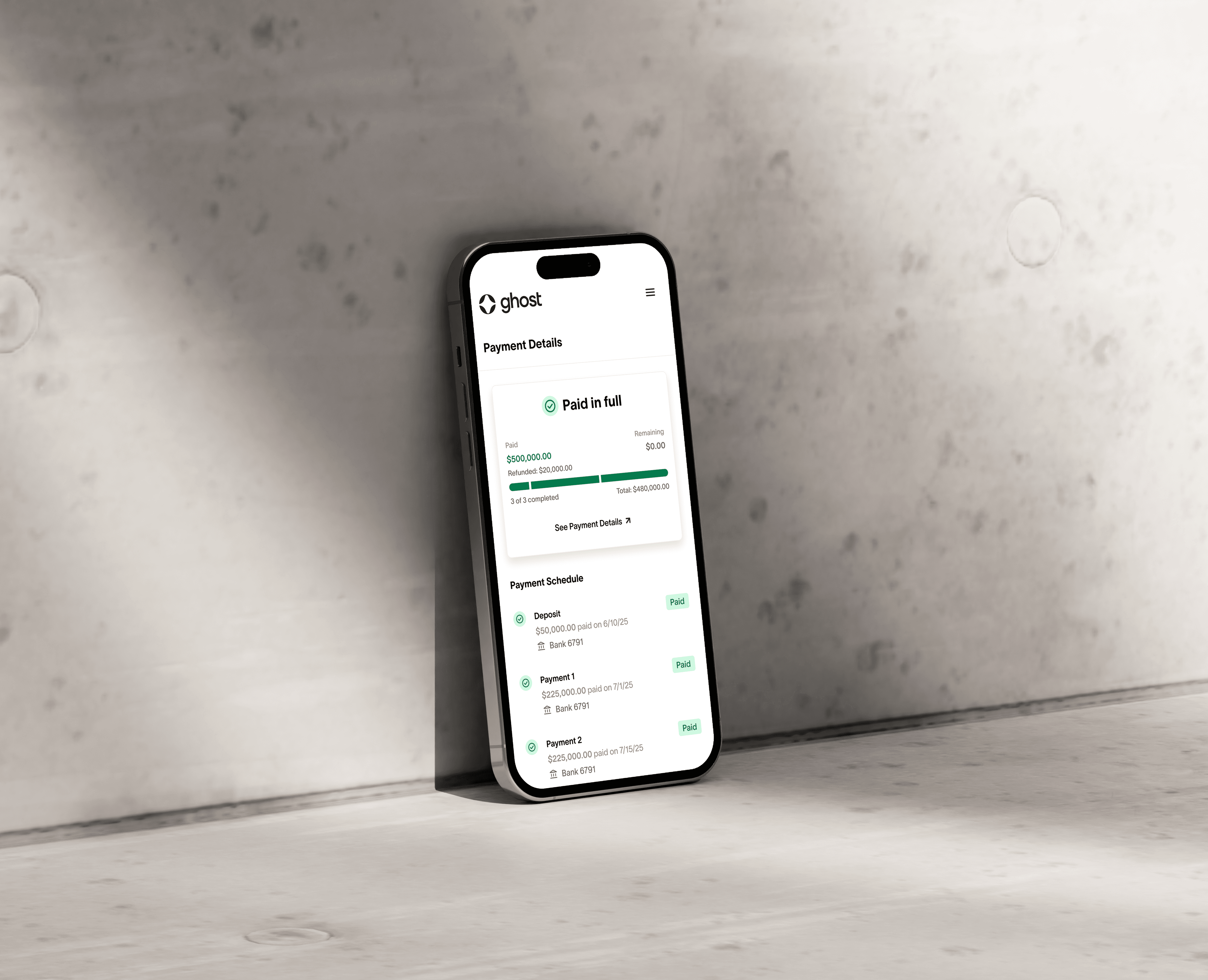
^ Mobile buyer experience
Looking Back
Given the mass scope I’d leverage rapid prototyping earlier to de-risk faster
Constraints drove better design
Operations leadership and I also ideated leveraging our internal AI-powered assistant for historical freight insights and real-time tracking.
^ Future idea for real-time insights via AI-powered chat
Ghost
Payment flexibility for hundreds of merchants
Ghost’s B2B payment functionality was narrow with low adoption. Significant manual involvement was required to support multi-millions in weekly order values.
^ Expanded functionality in redesigned payments product
My Role
Led end-to-end research and design
Aligned leadership across 3 organizations
Designed flexibility and operational control
Impact
24% adoption to 96%
1,000 monthly hours saved (=6 FTE)
Zero failures across $47M in transactions
Streamlined infrastructure and workflow
Shortened deal lifecycle
^ Extremely limited capabilities in legacy product
Business Challenge
Our rigid system couldn't serve clients (single-person shops to Fortune 500 companies) threatening retention and competitive advantage.
Finance manually reconciled 76% of payments across three systems, and 40% of orders were delayed awaiting payment.
Breaking Down the Problem
Auditing 150 deals revealed operational chaos: Numerous use cases, API rate limits, 40+ handoffs per deal. 78% of deals required fully custom terms, and our stakeholders had competing needs.
^ Numerous payment scenarios to support / Workflow discovery
^ Comprehensive fulfillment blueprint
Approach & Solution
I embedded with Operations and Finance, mapping out their intensive workflows. My PM, eng leads, and I targeted payment opportunities across dual tracks:
Product: Event-based triggers, installment flexibility (10+), multiple payment methods
Operations: Deal acceptance payment terms, templatized term options, Finance approval gates
^ Flexible payment plans
Impact
Within 3 weeks of launch we saw:
A 57% reduction in operational toil (35hrs → 15hrs/deal)
Zero failures across $47M in payments
Usage rise to 96%, and event-based triggers influenced milestone tracking
^ Refined buyer experience
Looking Back
Engineering partnership was critical for navigating constraints
Influencing operational efficiency can be just as impactful as UI refinement
Etsy
Ad platform performance tools for 2.1M sellers
Etsy Ads sellers ($450M annual spend) couldn't interpret metrics or adjust campaigns when listings sold out.
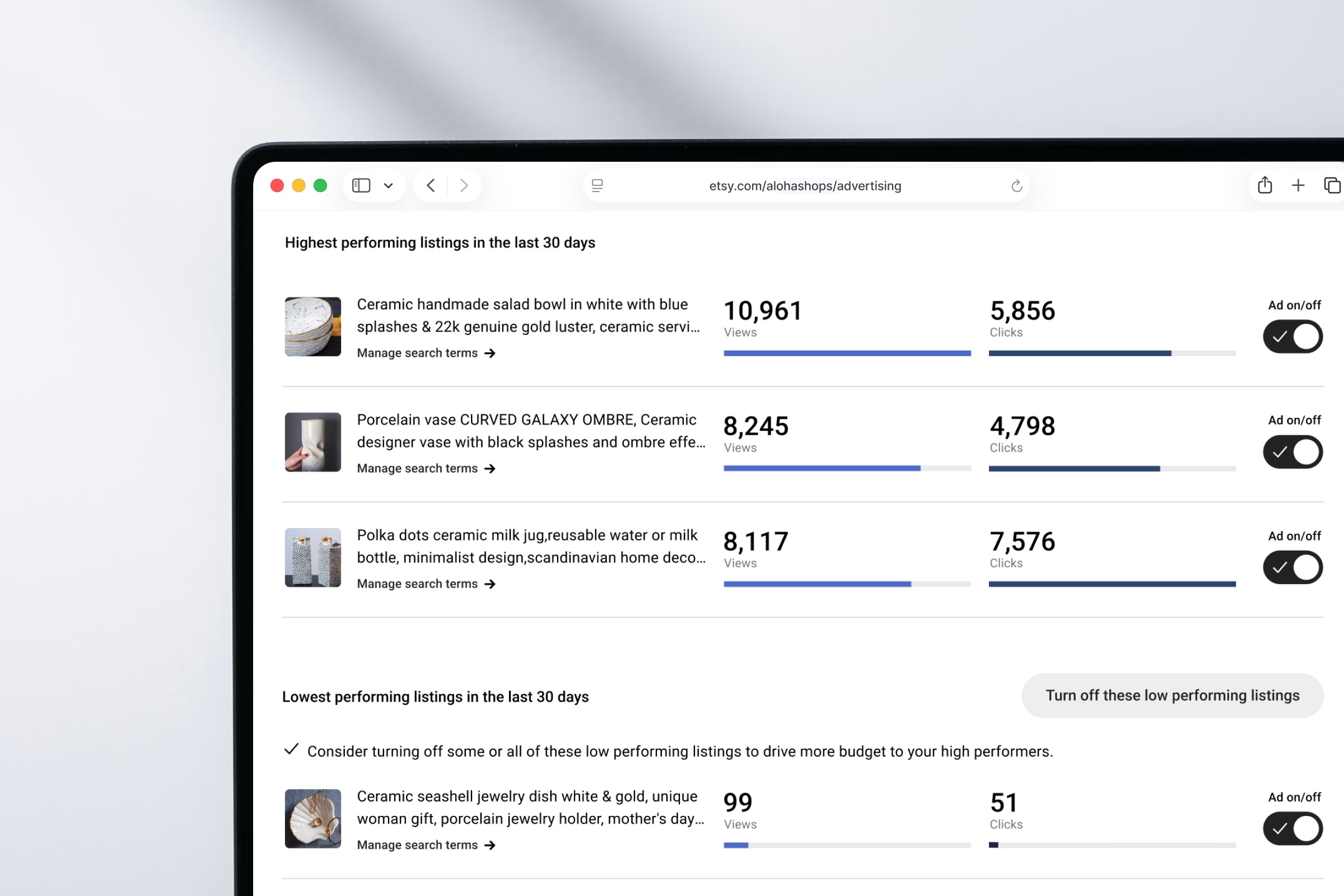
^ Introduction of performance metrics
My Role
Led platform strategy, shipping 8 features
Built self-service tools
Drove 400-seller beta group
Impact
85% optimized budget
82% seller approval
Increased retention
Ad tech efficiency at scale
Business Challenge
Advertisers couldn't stop ads on sold-out listings, wasting budget, and struggled interpreting performance metrics.
^ Mapping ad flow and touchpoints
Breaking Down the Problem
Platform mapping: Tracked ad operations uncovering barriers in seller visibility.
Performance optimization: Built metrics dashboard (ROAS, CTR, CPC) with budget controls, pairing with data team on real-time aggregation.
Campaign management: Optimized access to controls and restructured bulk editing.
Attribution reporting: Modernized search terms analytics page yielding 77% helpful rating
^ Feature workshops / Unstructured, legacy search terms dashboard
Impact
400-seller beta validated features for 2.1M advertisers, driving 28+ day retention increase and 82% approval.
Looking Back
Eng input on data complexity was key and I should have scoped with them earlier
After a failed first attempt on platform mapping, paired workshops unstuck us in hours
^ Redesigned search terms attribution and campaign management
Ghost
AI-powered validation in hours, not weeks
Rapid prototyping leveraging AI tools evolved how my team at Ghost validated internal explorations.
My Role
Built AI-powered prototypes
Refined with PM/eng and partners
Aligned across leadership
Impact
Assumptions tested in real-time
Roadmap informed by feedback
Higher confidence in quality
^ Using Lovable to test into logic
The Challenge
Our team’s domain was exceptionally broad and deeply technical. We needed a way to shorten feedback loops and rescope with confidence.
Approach 1 (Lovable & Claude)
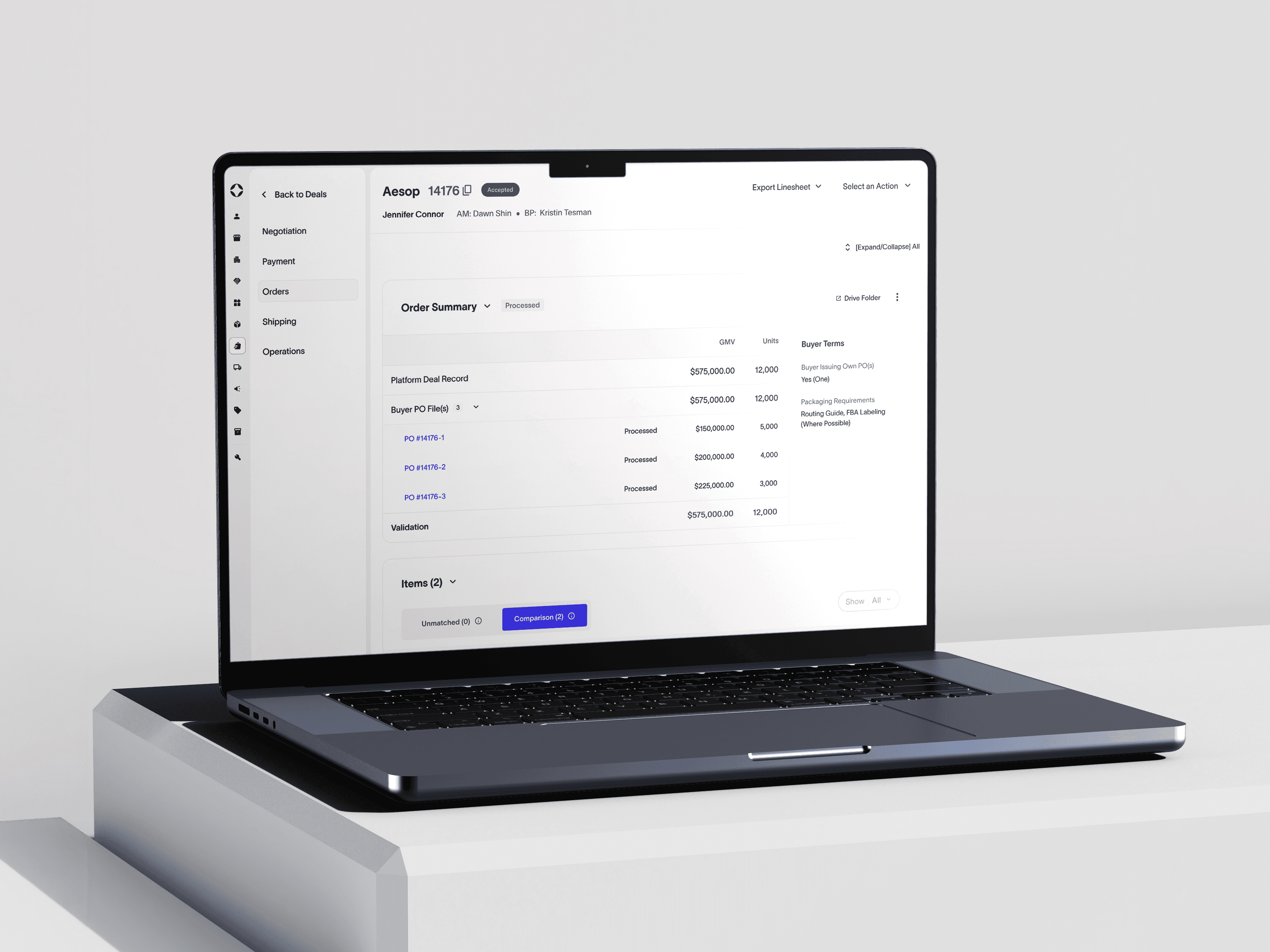
Collecting deal terms involved complex, conditional shipping data. I created an interactive prototype with foundational logic that could be modified based on stakeholder feedback.
^ Shipping questionnaire prototype
Approach 2 (TableFlow partnership)
Partnered with third party to create custom integration for order splitting and reconciliation. It automated a highly manual process, and informed how our platform should be shaped.
^ Order splitting and reconciliation automation
Approach 3 (Cursor & pairing)
The lead engineer vibe coded a shipping calculator while we paired on data modeling, enabling faster design refinements and accelerating partner delivery.
Looking Back
This builds on my Etsy work running a 400-seller prototype group testing 14 features.
Invalidate early to reduce waste
Tangible experiences can be more influential than polished concepts
^ On-platform freight calculator